
Skip to content
We use only essential cookies to keep you signed in and remember your preferences. See our Cookie Policy.
TestStop
MocksPracticeResourcesIndiaBlogPricing
Sign in
Questions › UoH › UoH 2019 › Q81
1 mark, −0.33Microeconomics › Demand theory and elasticity › Income and substitution effects: the Slutsky equationHardabout 2 min

UoH 2019 Question 81: Demand theory and elasticity

Answer following three questions (80 to 82) from information given in Diagram 1

[Diagram 1: A consumer's indifference-curve diagram with Good X on the vertical axis and Good Y on the horizontal axis. Initial equilibrium is at point A where indifference curve I1 is tangent to budget line BC1. The price of commodity Y falls, so the budget line pivots out to BC2 and the new equilibrium is at point C on the higher indifference curve I2. A dashed compensated budget line parallel to BC2 is tangent to I1 at point B. Quantities of Good Y are marked Y1 at A, Y2 at C and Ys at B; quantities of Good X are marked X1 at A, X2 at C and Xs at B.]

In Diagram 1, the movement of the consumer from point A to point B is due to
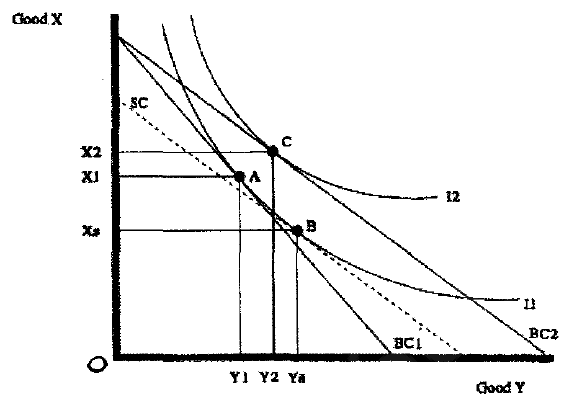
Indifference curve diagram with Good Y on the horizontal axis and Good X on the vertical axis. Budget line BC1 is tangent to indifference curve I1 at A (X1, Y1); after the price of Y falls, the flatter budget line BC2 (same X intercept) is tangent to the higher curve I2 at C (X2, Y2); a dashed compensated line SC parallel to BC2 is tangent to I1 at B (Xs, Ys), with X2 > X1 > Xs and Y1 < Y2 < Ys on the axes.

Tap an option to check your answer.

Answer and worked solution

Checking your account…

Demand theory and elasticity has come up 161 times in 7 exams since 2004.

What this question tests

This question is on Income and substitution effects: the Slutsky equation, part of Demand theory and elasticity in Microeconomics.

Splitting a price change into a substitution effect and an income effect, and why Giffen goods break the law of demand.

TestStop has 29 past-paper questions on this subtopic.

Practise Demand theory and elasticityMore on Income and substitution effects: the Slutsky equation

Similar questions from other papers

  • CUET-PG 2026 · Q3Goods are substitutes when an increase in price of one leads to _ of other commodity.
  • IIT JAM 2026 · Q5Let e, R, and p represent own price elasticity of demand, total revenue, and price, respectively for a good. If (∂ R)/(∂ p)<0, then
  • UGC-NET 2026 · Q24If the demand function is Q = 100 - 2P, when P = 25; then elasticity of demand will be:
  • CUET-PG 2025 · Q39The decision by consumers to buy larger quantities of a good at each possible price can not be caused by
  • GATE 2025 · Q28The demand function is given as log Q = log A + 0.5log P, where Q is quantity, P is the unit price of the good and A is a positive real number. The own price elasticity…

Question from the UoH 2019 paper. Solutions are TestStop's own. Not affiliated with or endorsed by any examination authority.