
Skip to content
We use only essential cookies to keep you signed in and remember your preferences. See our Cookie Policy.
TestStop
MocksPracticeResourcesIndiaBlogPricing
Sign in
Questions › GATE › GATE 2021 › Q27
2 marksGame Theory › Game theory and strategic behaviour › Pure-strategy Nash equilibriumHardabout 3 min

GATE 2021 Question 27: Game theory and strategic behaviour

Consider an intersection of roads without any traffic light. Two cars A and B approach an intersection and they want to proceed as indicated by respective arrows in the diagram (Car A travelling one direction, Car B travelling a crossing direction toward the same intersection point). If both proceed without stopping and there is an accident, then A would have a payoff of −100 and B would have a payoff of −500 (since B is responsible for the accident). If one stops, and the other proceeds then the payoff is: −5 and 10, respectively (stopper gets −5, proceeder gets 10). If both of them stop, then it takes a little longer to reach their respective destinations, they have a payoff of −5 each. Find the Pure Strategy Nash Equilibrium (PSNE) of the players (Car drivers).
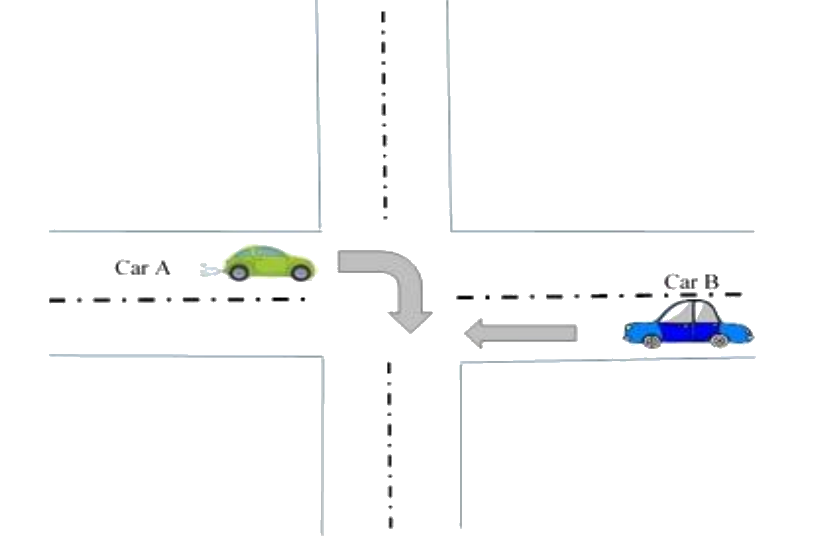
Top-down view of a four-way road intersection with no traffic light, drawn with dash-dot centre lines. Car A (green) approaches from the left, and a curved arrow shows it turning right at the centre, heading down the lower road; Car B (blue) approaches from the right, and a straight arrow shows it going straight ahead to the left, across Car A's turning path.
Select all that apply.

Answer and worked solution

Answer: (B) and (C)

Payoff matrix (Car A payoff, Car B payoff):

B: StopB: Proceed
A: Stop(−5, −5)(−5, 10)
A: Proceed(10, −5)(−100, −500)

Checking each strategy profile for whether either player wants to unilaterally deviate:

(Stop, Stop): If A deviates to Proceed (while B stays at Stop), A's payoff rises from −5 to 10 — A wants to deviate. Not an equilibrium.

(Stop, Proceed): If A deviates to Proceed, A's payoff falls from −5 to −100 — A does NOT want to deviate. If B deviates to Stop, B's payoff falls from 10 to −5 — B does NOT want to deviate either. This IS an equilibrium.

(Proceed, Stop): By the same logic (symmetric to the case above), neither player wants to unilaterally deviate. This IS an equilibrium.

(Proceed, Proceed): If A deviates to Stop, A's payoff rises from −100 to −5 — A wants to deviate. Not an equilibrium.

This is a classic anti-coordination ('Chicken') game: it has exactly two pure-strategy Nash equilibria, where one driver proceeds and the other stops (in either arrangement) — both (B) and (C) are valid PSNE. This matches the MSQ (multi-select) format of the question, which allows for more than one correct option.

The trap: (A) (Car A, Car B) = (Stop, Stop)

Students sometimes assume '(Stop, Stop)' must be the equilibrium since it seems like the 'safest' or most cooperative-looking outcome, without formally checking that either driver has an incentive to unilaterally deviate to Proceed once they know the other is stopping (since Proceeding while the other Stops yields a strictly better payoff, 10 vs −5).

Game theory and strategic behaviour has come up 61 times in 6 exams since 2008.

What this question tests

This question is on Pure-strategy Nash equilibrium, part of Game theory and strategic behaviour in Game Theory.

Outcomes from which no player wants to deviate, and classic games that illustrate them.

TestStop has 20 past-paper questions on this subtopic; the nearest in year are below.

  • IIT JAM 2022 · Q29Which statement is CORRECT for Game A and Game B? Game A (Battle of the Sexes): Mary prefers a movie, John…
Take this paper as a timed mockMore on Pure-strategy Nash equilibrium

Question from the GATE 2021 paper. Solutions are TestStop's own. Not affiliated with or endorsed by any examination authority.