
Skip to content
We use only essential cookies to keep you signed in and remember your preferences. See our Cookie Policy.
TestStop
MocksPracticeResourcesIndiaBlogPricing
Sign in
Questions › DSE › DSE 2007 › Q5
1 markMicroeconomics › Consumer preferences and utility › Revealed preferenceHardabout 4 min

DSE 2007 Question 5: Consumer preferences and utility

In the figure, the original budget line was 5F+10C=2005F+10C=2005F+10C=200, and Anita purchased 30 units of F and 5 units of C. At two later dates, budget lines (1) and (2) applied, with the same preferences throughout. As a rational consumer, which market baskets (labelled A, B, C, D on the figure) might she have purchased at the later dates?
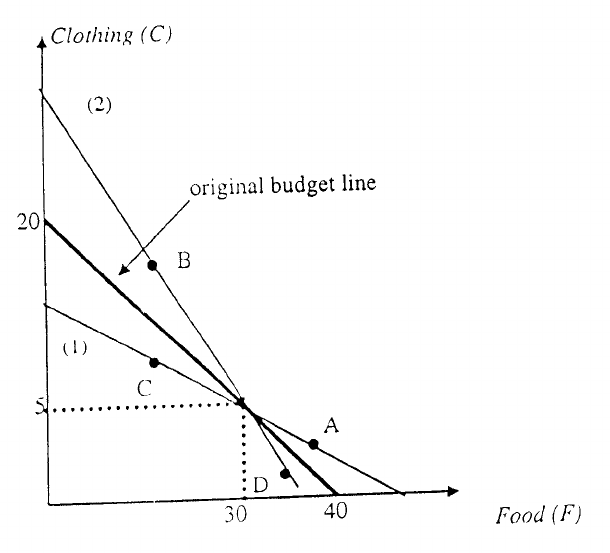
Budget-line diagram with Food (F) on the horizontal axis and Clothing (C) on the vertical axis. The bold original budget line runs from C = 20 on the vertical axis to F = 40 on the horizontal axis and passes through the original bundle (F = 30, C = 5), marked by dotted lines to both axes. Two later budget lines also pass through (30, 5): line (1) is flatter (lower vertical intercept, below 20, and a horizontal intercept beyond 40), with point C on it up and to the left of (30, 5) and point A on it down and to the right; line (2) is steeper (vertical intercept above 20, drawn only down to just past D, short of F = 40), with point B on it up and to the left of (30, 5) and point D on it down and to the right. A and B lie outside (above) the original budget line; C and D lie inside (below) it.

Tap an option to check your answer.

Answer and worked solution

Checking your account…

Plain-text version

In the figure, the original budget line was 5F+10C=200, and Anita purchased 30 units of F and 5 units of C. At two later dates, budget lines (1) and (2) applied, with the same preferences throughout. As a rational consumer, which market baskets (labelled A, B, C, D on the figure) might she have purchased at the later dates? (A) A, B (B) A, D (C) B, C (D) C, D

Consumer preferences and utility has come up 93 times in 7 exams since 2007.

What this question tests

This question is on Revealed preference, part of Consumer preferences and utility in Microeconomics.

Inferring preferences from observed choices: the weak and strong axioms of revealed preference and consistency checks.

TestStop has 12 past-paper questions on this subtopic.

Practise Consumer preferences and utilityMore on Revealed preference

Similar questions from other papers

  • CUET-PG 2026 · Q1Which among the following is not an assumption of Indifference Curve?
  • GATE 2026 · Q28Madhu's utility function is given by U=max (2C,3F), where C represents the amount of cloth and F represents the amount of food. Her preferences DO NOT satisfy which one…
  • UGC-NET 2026 · Q55Which of the following is NOT the assumption of the Revealed Preference Hypothesis?
  • CUET-PG 2025 · Q1If the demand function is given as P = 110 - Q² and market equilibrium is attained at P₀ = 29 and Q₀ = 9, calculate the consumer surplus.
  • GATE 2025 · Q38A Constant Elasticity of Substitution (CES) utility function is given as: U_(CES)(z₁,z₂) = 1/δ(z₁^δ + z₂^δ) where z₁ and z₂ are two goods, and δ ≤ 1, δ ≠ 0. A…

Question from the DSE 2007 paper. Solutions are TestStop's own. Not affiliated with or endorsed by any examination authority.